More and more companies sell through channel partners, and more and more partners use AI in their daily work. But while that can easily become a chaotic flow of faulty information that cascades down your channel, there are ways to control the accuracy of information that goes out. Through all the people involved in your channel – and AI.
Look. Everyone makes mistakes. You may say the wrong price because you think the 7 looks like a 1. You might send files that should have been erased ages ago, that have a typo on page 5 and so on. But while this is usually not a big deal, and can usually be fixed with a follow up email, things get more difficult when you work with channel partners. Just think about it: everything you share with your channel, all the information and all the files, is made to travel through a long line of people. It doesn’t stop with the person you send it to, but travels from sales manager to rep, from rep to resellers and customers etc., and every step takes it further away from you and your chance of fixing it with a simple email.
The challenge is even bigger in regulated industries like medtech, pharma, finance or any other area where compliance is everything. There is, quite simply, no room for error in those industries, which makes it extremely risky to not be able to control what is said or shared. To not be able to see when errors are made, and not even know about them before it’s done some damage.
So, how can you actually control the information flow throughout the entire line of people who are to receive it? And how can you keep compliant to the regulations that govern your industry, even when sharing information with people you may have little contact with?
Controlled information sharing in the AI era
This may seem like an impossible challenge: one that was tough before, when “all” you had to do was to control the material and information you shared, throughout the entire line of channel partners, customers and end users, but that has become infinitely more difficult with the rise of AI. After all, more and more channel partners are embracing the technology, and using generic AI to fetch information, find material and – even worse – create sales and marketing material.
And of course they do. Partner reps are busy people who want things like a localized one-pager, a quick translation or a punchier email for a specific customer, preferably by this afternoon, or even sooner if possible. And right now it actually is. In fact, just about anyone can now open a free AI tool, paste in some product info and get a polished, professional-looking brochure in a matter of seconds.
So it’s only a natural development: of course they’re going to use the tech at their disposal, and of course they’ll do the thing that saves time instead of waiting around for a partner rep to send something over.
The problem: generic AI is pretty bad
The only problem is, most of the information they get, or create, is not entirely accurate. The AI fills the gaps with fluff because it’s built to do exactly that. It will round a number, and add a benefit that sounds about right, and translate a safety warning a little too freely, and maybe even make up a study to back up a claim it just thought of.
And it all looks right, even though it isn’t, which makes it so much more dangerous. Because how on earth can you expect a busy partner, or a customer, to tell the difference?
How to behave when partners use their own AIs
This tiny little fact makes unsanctioned AI usage an unprecedented risk that faulty information starts to cascade through your channel. After all, having partners use their own, generic AI means that every day can come with a new set of faulty material and information, in every language, on every market. Information that seems to originate from you, and your brand, though it was made without your say so and cannot be traced back to you because it originates from a partner rep with a personal AI account.
These are the things nightmares are made of. And that’s before we consider the fact that you may not even know its happening. You might not know that partners are crafting strange brochures until a customer, user, or quite possibly an auditor, shows it to you. Which is enough of a scare to keep the heaviest sleeper awake throughout the night.
So how should you behave? How should you tackle this risk, this possibility?
Well, the first instinct is often to ban it, which is understandable, but rarely works (because partners will keep using AI anyway, on their own laptops and phones, and you’ll know even less about what’s going out under your name). Instead, what you should do is give them something that beats the free tools by such a margin that choosing between them isn’t even a question. Which is where PAM comes in.
Meet PAM
PAM is an AI that doesn’t hallucinate. She literally can’t. She only works from your approved material, and doesn’t invent sources or information. Instead, she’s simply the best partner manager there is: always online, always available, always there to answer questions, point to the right material and get accurate information into the right hands.
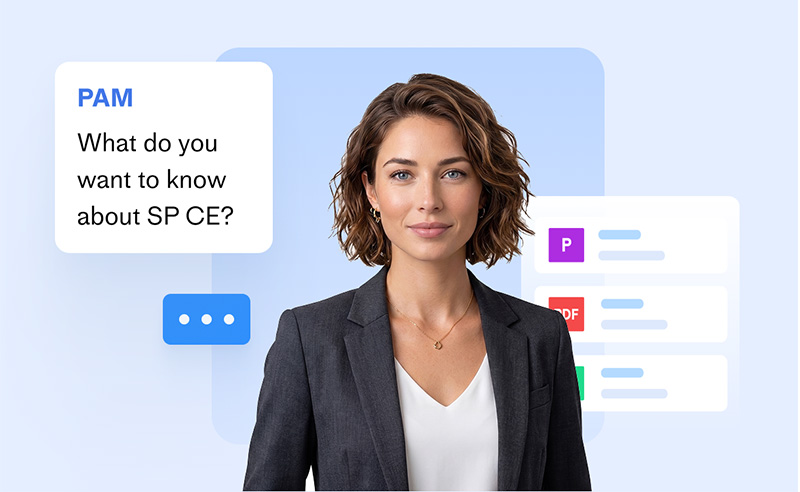
Which means that anytime a partner needs a customer-ready answer, a summary in their own language or the latest spec sheet, they can ask PAM instead of some public chatbot, and get something that hasn’t only been been approved but that is also way better suited for their audience. Because it’s made with the correct information. Because every source has been collected, and curated, by people who actually know what they’re talking about. Namely you and your team.
That way, partners will no longer need to use a run-of-the-mill AI – as you have already given them a better alternative. One that doesn’t make mistakes. One that won’t share the wrong file. One that will never accidentally think the 7 looks like 1 and that will never leave a typo on page 5.
Keeping faulty files and information from cascading down your channel
You don’t have to use PAM. We’d be super happy if you did, of course, but the point here is another: whatever AI you choose to replace the generic ones your partners are using, it should fit neatly into the structure and tools you’ve already put in place to control content and information sharing. Otherwise, you’ll be working with a scattered set of tools that leaks information and doesn’t do much good.
And yes, PAM happens to fit that description perfectly. She’s docked into the SP_CE Partner Portal, which not only provides you with a way to control all files everywhere, from one place, but also provides your partners with all the information, material, training and AI power they need.
But we won’t go on about that. Unless you click here to book a meeting with one of our experts, who can go through exactly how SP_CE and PAM work.